



What’s It About
In the early 1900s, young Sarah Rector believes there’s oil beneath the barren land she’s allotted in Indian Territory. As greedy sharks close in, Sarah turns to family, friends, and some Texas wildcatters to maintain control of her oil-rich land, eventually becoming one of the first female African American millionaires.


MOVIESinMO REVIEW
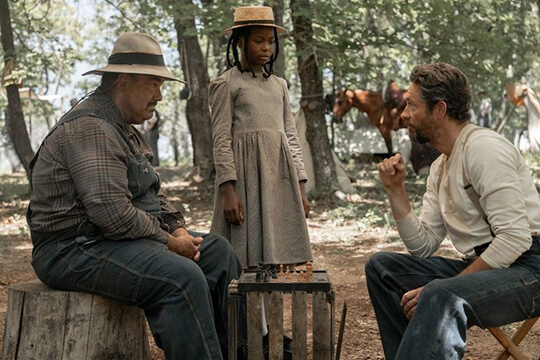
Set in 1913 Oklahoma, “Sarah’s Oil” tells the amazing true story of Sarah Rector, an 11-year-old Black girl who became one of America’s first Black female millionaires when oil was discovered on land she owned. Director Cyrus Nowrasteh and his wife, Betsy Giffen Nowrasteh, adapted Tonya Bolden’s 2014 book “Searching for Sarah Rector: The Richest Black Girl in America” into a film that works as both educational entertainment and family-friendly drama. The movie starts with a powerful quote from oil tycoon J. Paul Getty: “The meek shall inherit the earth, but not its mineral rights.” This sets up the central conflict perfectly. Sarah (newcomer Naya Desir-Johnson) receives 160 acres of supposedly worthless Oklahoma land because she’s a descendant of both the Muscogee Creek Nation and formerly enslaved African Americans. Under the Treaty of 1866, she qualifies for this inheritance. While everyone thinks the property is good for nothing except tornadoes and snakes, Sarah believes differently. She literally puts her ear to the ground and insists she can hear oil underneath. Her parents react like most practical adults would. Father Joe Rector (Kenric Green) wants her to sell the land since their family desperately needs money. Mother Rose Rector (Sonequa Martin-Green) shares his doubts at first. But Sarah refuses to give up, telling her mama, “God gave me ears to hear. He gave me that land for a reason.” This religious faith threads throughout the movie without becoming preachy or heavy-handed. Sarah and Joe visit several oil companies trying to get someone to assess the land. Being 1913 in Jim Crow Oklahoma means they face brutal racism everywhere they go. White-owned businesses literally throw Joe out the door. People stare at them with hate on the streets. The struggle to be taken seriously becomes as challenging as proving the land’s worth. Enter Bert Smith (Zachary Levi), a charming con artist from Texas who specializes in swindling rich widows but also chases oil opportunities. He’s living in a wildcatter camp with his Mexican business partner, Mason “Mace” Hernandez (Mel Rodriguez). An unlikely alliance forms between Sarah and Bert, though the question remains whether this smooth-talking drifter can be trusted with a young Black girl’s future. Levi gives one of his best performances as Bert. He’s nearly unrecognizable behind a beard, playing against his usual heroic type. Bert is not a white savior character; he is simply a flawed person pursuing financial gain who slowly discovers that he just may care about doing the right thing. The movie does not shy away from depicting his own prejudices. Bert makes incredibly damaging comments about his own racism, but he is still shown as someone who is capable of change. This complexity makes Bert feel believable instead of just being this perfect ally. The supporting cast elevates the material considerably. Martin-Green and Green (married in real life) have natural chemistry as Sarah’s parents. They play loving, supportive people trying to protect their daughter in an impossibly hostile world. Garret Dillahunt creates a memorable villain as oil company partner “Big” Jim Devnan—corrupt, greedy, and willing to go to extreme lengths to get what he wants. Attorney Kate Barnard (Bridget Regan) joins Sarah’s legal team as the stakes continue rising. But make no mistake—this is Desir-Johnson’s film. She carries the emotional weight beautifully, balancing childlike enthusiasm with wise-beyond-her-years determination. She makes you believe this girl could stand up to powerful, racist businessmen and refuse to back down. Her performance ranks among the best youth acting in recent films. She never overplays the drama or goes too big with emotions. Instead, she keeps everything grounded and genuine. The movie stretches believability in how Sarah negotiates business deals. The film hints she learned everything from reading books, but an 11-year-old talking about royalties and wholesale oil prices feels exaggerated for dramatic effect. Still, Desir-Johnson plays Sarah with such charm and conviction that you go along with it. The character becomes a stand-in for modern audiences learning about the structural cruelty of the past. The Nowrastehs filmed on location in Oklahoma, and the cinematography captures both the beauty and harshness of early 1900s oil country. The pacing stays solid throughout most of the runtime, keeping tension high as Sarah faces increasingly dangerous opposition. The film takes violence quite seriously, maintaining a tension while not being overly graphic, making it okay for family viewing but still shows real danger. In combat, the film does not shy away from laying out the stakes of the violence, but it tries to not offer excessive bloodshed. “Sarah’s Oil” draws obvious comparisons to Martin Scorsese’s “Killers of the Flower Moon,” which also explored violence against people of color in Oklahoma who owned oil-rich land. Where Scorsese’s film was dark and brutal, this movie aims for family-friendly territory. Both approaches have value. “Sarah’s Oil” makes this history accessible to younger viewers and creates a crowd-pleasing experience without completely sanitizing the ugliness of racism. The film walks a careful political line. It condemns racism clearly, but frames injustice as mostly individual evil rather than examining deeper systemic problems. This allows the movie to appeal to different audiences—Christian conservatives who appreciate stories of good people helping vulnerable minorities, and more progressive viewers who want stories about perseverance against oppression. Some might criticize this safe middle ground, but others will appreciate that it educates without alienating viewers. Sarah Rector’s actual story deserves more attention. Most Americans never learn that a Black girl became a millionaire in 1913 Oklahoma, or that Native Americans and African Americans with dual heritage could receive land through the Dawes Allotment Act. The film does a good job of drawing attention to this underrepresented history it doesn’t simply focus on Sarah’s eventual riches is not just in the overtly religious elements, which felt organic. Sarah’s religious belief propels her faith about the land; her mother’s sacredness offers strength. The film represents prayer and God without any kind of preaching. Christian audiences will rejoice to see these elements, without crowding out those from other faiths or making the narrative feel preachy. Adult Sarah Rector is voiced by Tamala Jones, and she narrates occasional reflections on her childhood in an older, wiser voice. This works well, as a means to remind the audience that Sarah made it through these struggles and lived to share her story. Sarah’s narration does not belabor the point or intrude on the narrative, it simply allows the audience to enjoy the story as it unfolds. The third act pours it all on, and the final conflict between Sarah and increasingly aggressive opposition pits Sarah against her antagonists. I won’t spoil any plot, but I will say that in light of what a dogged fight the antagonists have been all along; the ending felt slightly rushed in resolving. The film’s resolution would have been more satisfying with a little more breathing space in the finale. However, the film wraps up with an optimistic tone, finally acknowledging that the conflict was just one chapter in a much bigger story of stolen land and racial discrimination. “Sarah’s Oil” is not a revolutionary change, but it only accomplishes what it intended to. It entertains families, educates us on history we have largely forgotten, and celebrates an extraordinary young woman who refused to let racism and greed ruin her life. The performances across the board stay strong, with special recognition deserved for how the film handles its young protagonist with respect rather than condescension. In a time when much of what we all consume can feel exhausting or downright nasty, there is something to be valued about a film that embraces kindness or hope without becoming too sappy or fake. It is an entirely respectable drama that is marked by great performances and serves as a reminder about the worth of stories like Sarah Rector’s. It is a film that affirms that it is possible to address difficult subject matter in an entertaining and accessible way, while also not dumbing things down or simply disregarding any convictions about nuance altogether. For anyone interested in American history, and are usually not offered access to the often neglected narratives of Black and Native American communities in the early 20th century, “Sarah’s Oil” offers a pleasant opportunity into this history. This is the kind of film that will likely spark a desire in younger viewers to want to further research Sarah Rector and her story’s relation to this fascinating time period. It is that educational value, along with the authentic merits of good filmmaking, that makes “Sarah’s Oil” well worth your time.
OUR RATING – A HEARTWARMING 7