

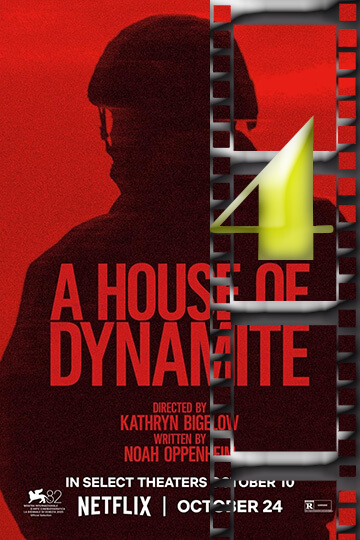

WHAT’S IT ABOUT
Radars at Fort Greely, Alaska, detect a nuclear missile. The president and his entourage must use the limited time they have to try to shoot down the missile before it reaches Chicago.


MOVIESinMO REVIEW
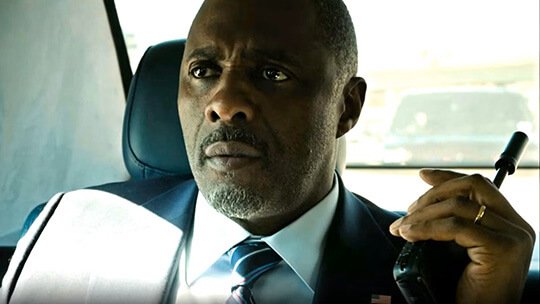
Director Kathryn Bigelow has had the good fortune of producing movies that touched your heart. Remember “The Hurt Locker” and “Zero Dark Thirty”? Yes, these were her brilliant works. When I heard she was making a film based on nuclear war, I was truly looking forward to it. Now, after watching “A House of Dynamite”, I am left with a big question: where is that director who used to give us no breathing space? The film poses a terrifying hypothetical question: What would the United States do if a nuclear missile were targeted at it? It probably wouldn’t be more than twenty minutes before we would have to come to grips with the situation, before everything changes forever. It’s a scary idea, and it certainly should make for a great film. However, Bigelow manages to take this nightmare scenario and make it less frightening and somewhat dull. So this is what happened: Defense mechanisms in the U.S. identified an intercontinental ballistic missile on a morning, “as usual,” that was going to hit Chicago directly. The one who fired it was totally unknown. It might have been North Korea, Russia, or even a rogue computer system that had gone out of control. Various characters of the film take action in response to the crisis: Olivia Walker is Rebecca Ferguson, who runs the White House Situation Room. Major Daniel Gonzalez, who is in Alaska and trying to get the missile, is played by Anthony Ramos. Jake Baerington, the Deputy National Security Advisor, who is hurrying around Washington to get the answers, is the character of Gabriel Basso. President, the one who has to take the final decision – Idris Elba is there. The cast is like a dream team, featuring Tracy Letts, Jared Harris, Greta Lee, and Jason Clarke, all doing their best. But their work is not so much appreciated, as their script is full of government jargon and characters only showing nervousness. Watching Idris Elba, who normally is able to dominate every scene, be confused and stunned is simply heartbreaking. The biggest problem with “A House of Dynamite” is the way it tells the story. Bigelow splits the story into three parts, each showing the same events but different viewpoints. Firstly, we observe the happenings from the Situation Room. Then we come to know through Jake’s eyes. Lastly, the President’s view is obtained. On the very first occasion, it is full of suspense and excitement. Bigelow is aware of how to raise the pressure even when the people are just in the conference rooms and looking at the computers. But the same action being repeated over and over destroys all the vigor they had. At the third time, viewers are no longer frightened but exhausted and longing for something new to come. The film loses all its power in the first instance through repetition. When the audience already knows about the missile coming, the conversations that they have already heard, and the people whom they have already seen panic, what is left? The enigma is gone. The fear is diminishing. And people start to look at their phones since they have already seen the movie twice. Another thing is the way our government is portrayed in the film. The characters here are professionals and smart, and could easily be from “The West Wing.” They talk in big words and use complicated military terms. They debate their options carefully. They are good people doing their jobs under a lot of pressure. It might have been acceptable 15 or 20 years ago, but in 2025, it sounds fake. We have had enough chaos to know that government doesn’t always run smoothly. The film is not in tune with the present and feels like it was made for a different era. The play written by Noah Oppenheim is full of so many acronyms and military terms that one has to have a dictionary in hand to keep up with the storyline. NORAD. STRATCOM. ICBM. Ground-based interceptors. Sea-based radar. All these sound like very important things, but they do not help us know what is really going on or why we should be interested. The conversations want to be intelligent like those written by Aaron Sorkin, but they end up being confusing and artificial. Despite all this, a few moments come out well. For instance, when Jake calls the Russian foreign minister to prevent the situation from getting out of control, you can feel the heaviness of the conversation. When General Brady, played by Letts, keeps on talking baseball as though it were the end of the world, it is a way of showing how people deal with stress in an unusual manner. These little bits of humans inside remind us that real people would be the ones facing this nightmare. However, these instances are covered with all the technical talks and repeated scenes. The end, or rather the absence of it, makes things worse. Three instances the movie shows the President deciding whether he should retaliate with a nuclear strike. Three instances, the screen goes dark before we see what he decides. We never see the destruction of Chicago. We never get to know who the attacker was. We never find out what the President does. The movie just ends. I understand what Bigelow is trying to convey. In reality, we would not have all the answers. There would be no good choices, only bad ones. But it is a film, not a philosophy class. We are entitled to some sort of conclusion after being witness to the same crisis thrice, but from a different angle for almost two hours. Not knowing acts as if the directors couldn’t make up their mind between the options, so they chose to do nothing. That is not profound or significant. It is a lazy move. What makes this so bad is the fact of knowing what Bigelow is capable of. She made us nervous by bombing teams working in Iraq. She depicted the intense raids, which gave the audience the feeling that they were happening right away and at the very location. She has the knack of building the tension and making the viewers get involved with the outcome. “A House of Dynamite” has everything one needs to make a great film – actors with talent, a scary premise, and a director who should have known better. However, the film fritters away the whole of these on a non-functional structure and a non-committal ending. Kirk Baxter’s editing is an effort to salvage the situation. Where he can, he elongates the tension, thus keeping the scenes going even when they are repetitive. But a great editor like him still cannot do the impossible of fixing an endlessly repetitive story that quits without finishing. The film is at its best when it makes us aware of how little prepared we might be for a nuclear war. It is hard not to feel that these scenes are real when you see people desperately trying to sort things out, arguing, making mistakes, and generally under great pressure. The fear in their faces lands. But these good moments get lost in everything else that doesn’t work. “A House of Dynamite” ends up feeling like a missed opportunity wrapped in frustration. The momentum is strong, then it ultimately falls apart under its own weight, and then it leaves us unresolved. Nuclear war deserves better than this. Kathryn Bigelow deserves better than this. And after sitting through twenty minutes three times or so, we certainly deserve better than this.
OUR RATING – A GOOD IDEA BAD ENDING 4