

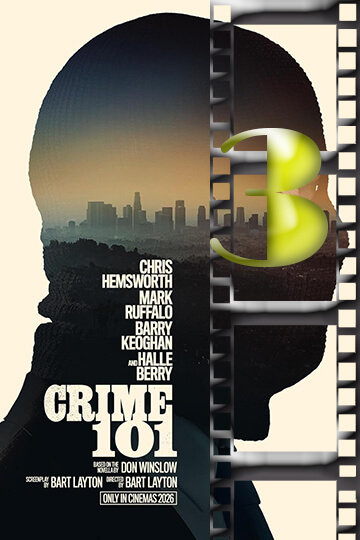

What’s It About
An elusive thief, eyeing his final score, encounters a disillusioned insurance broker at her own crossroads. As their paths intertwine, a relentless detective trails them, hoping to thwart the multi-million dollar heist they are planning.

MOVIESinMO REVIEW
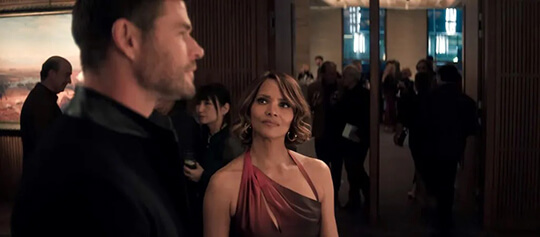
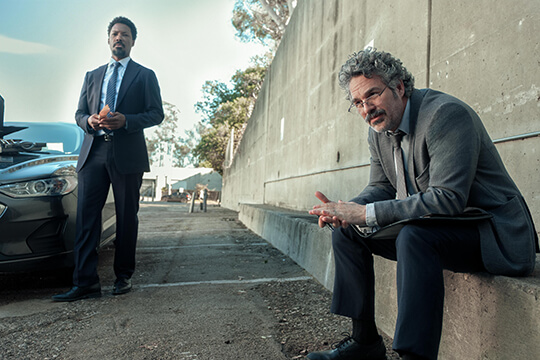
The film “Crime 101,” created by Bart Layton, has to walk a line because it’s going to create a heist film in Los Angeles, post-Michael Mann`s “Heat” (1995). Almost all of the notes of both films will be compared. Layton shows his admiration for “Heat” with images of the Los Angeles skyline that have inspiring aerial views, and with an electronic soundscape that sounds like the hum from a neon sign. The only real difference is that Mike (Chris Hemsworth), the protagonist, is an introverted criminal that does his job well but is a poor socializer. The film gives you a sense that you are waiting for Lou (Mark Ruffalo), the detective, to do or say something outrageous when he is chasing Mike, as would happen in “Heat.” Unfortunately, “Crime 101” never develops its own energy. The true crime documentaries about people robbing banks along Highway 101 are not enough to drive the story, and both the characters, on which the storyline is primarily based, keep the audience at a distance from them. For example, Mike’s female love interest, Maya (Monica Barbaro), appears to be in the film solely because the script states she should be there — she did not feel like she had a story-related reason for being there. This film’s current method of storytelling does not work because it focuses on the characters of Mike and Lou, who are both living in parallel lives (one breaking the law and one enforcing the law), but it does not have many parallels that connect them together. The main reason that Lou is trying to catch Mike, who commits crimes in LA, is that he is the only honest police officer in LA, or at least that is how it is written. Ruffalo plays Lou with a tired charm, like an old detective who’s seen too much. His marriage is falling apart, and he moves into a bare apartment by the beach, dragging his cat and a few boxes with him. Halle Berry and Barry Keoghan round out the cast. Sharon, who is an insurance broker and serves wealthy customers, is played by the actress Berry. Keoghan plays a loose cannon criminal who has been hired to interfere with Mike’s plans. The chemistry between Berry and Ruffalo is great, but they are not given enough opportunities to really shine together because their time is limited. Even though their moments together have a lot of shine, there simply aren’t enough of them. Berry is able to make her character work even though the character is a tired trope of a woman in a system that fails to recognize her worth. The scenes with Keoghan are much more chaotic and erratic. He brings an almost unpredictable level of danger to every scene he appears in; you are always waiting for something unexpectedly explosive to happen to him. In addition, there are far too many characters within the narrative; it’s like the freeways in Los Angeles with lots of lines but no clear path. A professional heist crew will identify which members of the crew aren’t contributing anything and then they will cut those individuals out of the crew. This movie would have benefited from doing the same thing. The movie contains very well-choreographed and executed action sequences, including the very first sequence, which depicts how Mike thinks. Hemsworth plays outside of his comfort zone, and I found it refreshing; however, he is not depicted as the typical charming hero, but rather as a man with a troubled past, and nothing bad will happen to him unless he has the opportunity to find a way to survive. The movie never provides any insight into how or why he has that troubled past; it only provides a few hints. There’s a story here about money, power, and inequality in LA, but the film doesn’t care enough to explore it. It’s like seeing a beautiful car with no engine; it looks good, but it doesn’t go anywhere. The plot is a mess. Mike, the jewel thief, wants one last job before he retires. Mike meets Maya after having an accident, but their romance seems forced. Mike’s boss (Nick Nolte) is unhappy about Mike quitting, and to create problems at work, he’s brought in Keoghan’s character. Meanwhile, partners Lou and Mike get into trouble while investigating Mike’s misconduct at work, but both Lou and Mike’s bosses are more concerned with public relations than with justice. Appropriately, Sharon, the insurance agent, is tired of being ignored and gets involved in helping Lou. Storylines jump around to different characters, but ultimately, none of the characters have viable ties to each other. The screenplay originally was adapted from a Don Winslow novella, but it gets bogged down with side plots that go nowhere. It is occasionally clever but doesn’t convey a sense of caring about the outcome of any of these characters. The film is an attempt to recreate the gritty style of 1970s crime films and utilize characterizations that are “morally minded.” However, it does not acknowledge the elements that made these films great, such as “heart, “risk-taking, and “style,” but rather takes the “safe road.” Mike is so flat in performance that he fails as a mystery; he fails due to his lack of excitement, an apartment that’s sparsely furnished, an emotional state that isn’t revealed, and his romantic relationship with Maya that lacks depth. Although Ruffalo does his best job with Lou, he has very poor material to work with. The final showdown between Mike and Lou has a moment of surprise, but it comes too late. By then, you’re just waiting for the credits to roll. Layton’s last movie, “American Animals,” was a heist film that felt alive and unpredictable. Here, he seems stuck. The film flirts with big ideas, corruption, greed, and trauma, but never follows through. It’s like a student who does the bare minimum to pass. “Crime 101” isn’t a terrible movie. It’s watchable, and the cast tries hard. But being okay isn’t enough in a genre that demands swagger. Without a standout performance or a pulse-pounding scene, the film fades from memory as soon as it ends. It’s a long drive to nowhere, just like the highway it’s named after. In the end, “Crime 101” is a missed opportunity. It has the pieces of a great crime thriller, but they never fit together. The movie improves toward the end, but it’s too little, too late. For a film that wants to be like “Heat,” it’s missing the fire.
OUR RATING – AN UNORIGINAL 3
MEDIA
- Genre – Thriller
Street date
- Digital – March 31, 2026
- 4K/Blu-Ray/DVD – June 30, 2026
- Video – 1080p
- Screen size 2.39:1
- Sound – English Dolby Atmos/TrueHD 7.1, French DTS-HD 5.1 Master Audio, Dolby Digital 2.0
- Subtitles – English, English SDH, Spanish, French
Extras
- none