

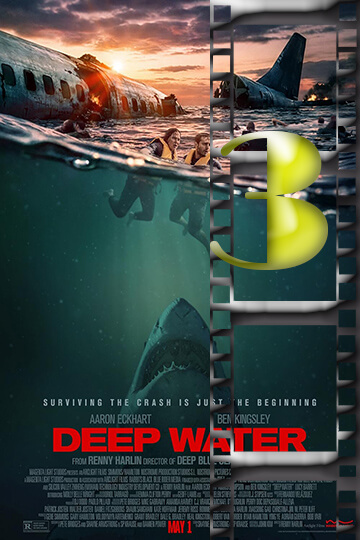

WHAT’S IT ABOUT
Terror strikes when a flight from Los Angeles to Shanghai goes down in the Pacific Ocean. Stuck on a sinking plane, survivors soon find themselves in a fight for their lives as man-eating sharks start to circle the wreckage.
MOVIESinMO REVIEW
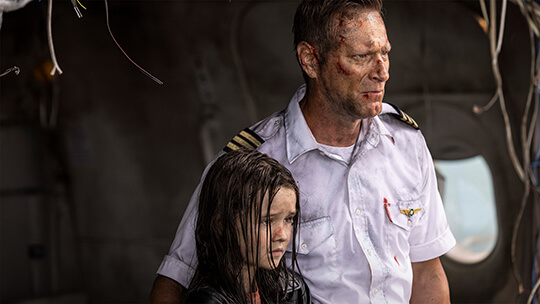
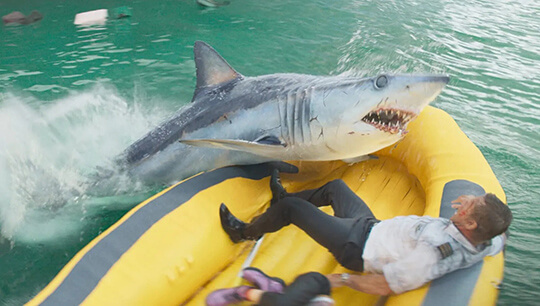
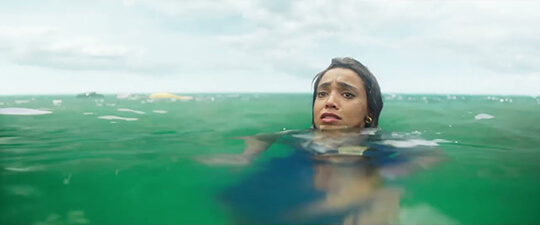
A broken lithium battery triggers a series of calamities that truly disintegrate a passenger airplane. The action goes quickly, and the anticipation is quite real. For a moment, it seems that the movie promises to deliver something spectacular. But once the airplane lands, the sharks arrive, and the movie fails to deliver anything after this. The difference between what the movie is capable of doing and what it ultimately does turns out to be the heart of the story. Harlin made his name in the 1990s, directing action flicks that were loud, bold, and interesting enough for audiences. However, even if he possesses enough talent to make great features, the script, which was developed by four writers, treats the actors as mannequins rather than its characters, making it impossible for the camera to help them make their characters alive. Take Ben, portrayed by Aaron Eckhart, for example. He is meant to be the unwilling hero who acts as the second-in-command only after the captain gets injured. But Eckhart has very little to work with. There is one line describing his background story about taking care of a sick child, and the line is followed by no elaboration. He emerges from the crash alive, gives commands, and appears anxious, but the movie never calls upon him to earn his rank. It is not because he deserves it. The same applies to Ben Kingsley in the role of the senior captain, who has around ten minutes of screen time at most. It is just a paycheck for him. This is where the movie falters the most. Deep Water assigns roles without any justification for why anyone is in them. A disaster movie operates on how significant the danger is to its characters, and this movie makes sure to keep everyone at a distance from the action. Parents head off to the airplane toilet, leaving their children behind, and then they disappear from the movie. A pair of gamers express some feelings for one another that go nowhere. An elderly woman gives dating advice to someone, and that is her contribution. None of these people have anything more than job descriptions. The movie confuses being there with serving a purpose. The one performance that breaks through belongs to Angus Sampson, playing Dan, the loud, chain-smoking passenger whose busted phone charger causes the whole disaster. Sampson leans all the way into the character’s ugliness, and it works, mostly because he is the only actor allowed to actually do something instead of just standing in a scene looking scared. That says less about his performance and more about how little the script gives everybody else. When the sharks show up, the film adopts a pattern that drones on without variation. It’s simple: a leg goes into the water, a shark bites it off, there’s blood, and the same cycle repeats. The special effects are terrible, bearing more of a resemblance to television than to cinema. There are a few shocking deaths that were meant to be funny, including the final helicopter scene that is the only time the filmmakers realized that this is a comedy, although it is too late for the realization to make a difference. What makes this harder to shake off is that the film clearly had the pieces to say something with its setup. Every survivor lands in a different broken piece of the plane, trapped with a different problem: one group stuck underwater sharing a shrinking air pocket, another drifting in open water with nothing but a life vest between them and the sharks below. That is a smart way to structure a disaster movie, giving each cluster of survivors its own version of the same nightmare. It is one of the few ideas here that actually shows some thought. But the film never follows through. It sets up interesting situations and then resolves them the same flat way every time, with a shark grabbing someone and the scene cutting away before it means anything. There is a version of Deep Water that works. Harlin has made a great shark movie before, back in 1999 with Deep Blue Sea, a film that knew it was ridiculous and had fun being ridiculous. This one wants credit for the same campy spirit without doing the work to earn it. It plays things safe right when it should be leaning into the chaos, and the result sits in an uncomfortable middle ground, too serious to be a good time and too silly to be taken seriously. It is hard to overlook how familiar I find this whole movie! Harlin had been doing all kinds of work as a director for years now, and here he is once again, handed another mid-budget flop even while other directors with better intuitions and names are waiting for their turn to make movies. It is this frustration that underlies every unexciting frame of Deep Water. The same old familiar names appear again and again, and so the end result is a film that is sometimes impressive, but for the most part, without any content to it. Deep Water is not the worst shark movie ever made. It has one genuinely strong sequence, one performance worth watching, and a handful of moments dumb enough to be enjoyable by accident. But a movie this uninterested in its own people cannot expect an audience to care what happens to them. The crash is thrilling. Everything after it is a chore.
OUR RATING – A SLIGHT BITE 3